FASTEST TYPIST IN THE WORLD
From Albert Tangora's hour at 147 WPM on a 1923 manual typewriter to Stella Pajunas' unbeaten 216, Barbara Blackburn's 50-minute Guinness record, and today's 300 WPM platform bursts — the verified records, and the math of why they're so hard.
By Soexya Khatiwada · Updated 2026-09-08
HOW DO YOU COMPARE?
Type the phrase below — find out where you rank against the world's fastest
Click here and type the words to check your speed
THE RECORDS
A century of verified speed — with the detail every listicle skips: how long they held it
Reportedly averaged 147 WPM for a full hour on a purely mechanical machine — every keystroke a physical lever throw. Widely cited as the fastest manual-typewriter performance ever, and arguably the most physically demanding record here.
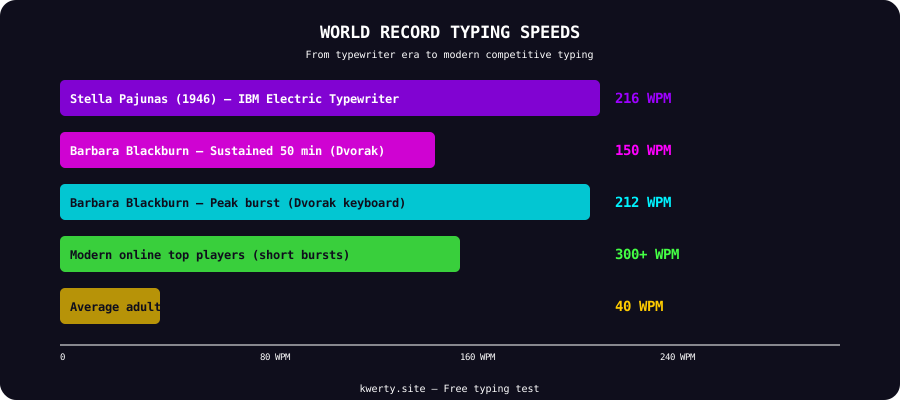
The most-cited official typing record: 216 words in one minute on an early IBM electric. No score on a standard test has officially beaten it in the 80 years since.
Guinness World Records listed her as the fastest English-language typist: 150 WPM held for 50 straight minutes (roughly 37,500 keystrokes) with peaks recorded at 212 WPM. She typed on the Dvorak simplified layout, which places most common letters on the home row.
Winner of the inaugural Ultimate Typing Championship, a live verified event. Known for sustaining speeds above 160 WPM across long real-punctuation texts on TypeRacer, with short-burst peaks reported as high as 256 WPM.
Monkeytype and TypeRacer leaderboards now show verified 60-second scores above 200 WPM and 15-second bursts above 300 WPM — checked by replay and consistency systems, but on lowercase, punctuation-free word streams. A different task from the dictation-style records above, which is why the numbers look superhuman by comparison.
WHY THERE'S NO SINGLE "FASTEST"
Typing speed decays with duration. A 15-second burst can run 50–80 WPM faster than the same typist's one-hour pace, because short tests hide the cost of fatigue, error correction, and unfamiliar words. That's why a 300 WPM Monkeytype burst and Blackburn's 150 WPM over 50 minutes don't compete for the same title — one is a sprint, the other a middle-distance race.
The text matters as much as the clock. Older records were set on dictation-style prose with capitals and punctuation; modern platform tests mostly use lowercase, punctuation-free common-word streams. Same fingers, meaningfully easier task. Any honest record needs three numbers attached: the speed, the duration, and the text.
THE MATH OF THE CEILING
One word = 5 characters. Divide the minute — record speeds leave impossibly little time per key
Typical adult speed. Slow enough to react to each letter individually.
Top ~1% of real typists. Already faster than per-key reaction — requires reading ahead.
Blackburn's sustained record pace. Whole words executed as single rehearsed motor patterns.
Pajunas' 1946 record. Four times faster than human reaction time to a visual stimulus.
Human reaction time to a visual stimulus is roughly 200–250 milliseconds. Every speed on this table past 60 WPM is faster than reacting — which means record typing can't work letter-by-letter at all. Elite typists read several words ahead and execute each word as one pre-compiled movement, keystrokes overlapping via rollover. The ceiling isn't finger speed; it's how far ahead the brain can buffer accurately.
RECORDS VS REAL TYPISTS
1,242 bot-excluded tests by 289 players on this site, March–August 2026
The gap is the story. Across every test ever recorded here, the median score is 36 WPM, the top 1% starts around 100, and the single fastest score on the site is 126 WPM — still 24 WPM below Blackburn's fifty-minute average and 90 below Pajunas' minute. Nobody in 1,242 tests has come within reaching distance of an 80-year-old record.
That's not discouraging — it's calibrating. World records are multi-thousand-hour outliers; meanwhile moving from 36 to 60 WPM is an achievable few months of technique work that changes daily computer use far more than the last 20 WPM ever would for a record chaser. Full percentile tables, the accuracy-vs-speed curve, and methodology are on the typing speed statistics page.
WHAT MAKES THEM SO FAST
Five things every record run has in common
PERFECT TOUCH TYPING
Every record holder uses all 10 fingers with strict home row discipline. Zero keyboard glancing. Each finger has assigned keys and never strays.
ROLLOVER TYPING
Elite typists press the next key before fully releasing the previous one. This overlap eliminates the gap between keystrokes — without it, the intervals in the math table above are physically impossible.
READING AHEAD
Above ~60 WPM there is no time to react to individual letters. Fast typists keep their eyes several words ahead of their fingers, buffering upcoming words as complete motor chunks.
OPTIMIZED LAYOUTS
Barbara Blackburn set her sustained record on Dvorak, which places the most common letters on the home row and alternates hands more often than QWERTY. Layout is not required — Pajunas and Wrona set theirs on QWERTY.
THOUSANDS OF HOURS
Without exception, every typist above 150 WPM has years of deliberate practice behind the speed. At record pace, typing is a trained motor skill closer to playing an instrument than to writing.
RELATED GUIDES
SPEED RECORDS FAQ
Common questions about the world's fastest typists
Who is the fastest typist in the world?
It depends on the duration. Sustained: Barbara Blackburn, recognized by Guinness — 150 WPM for 50 minutes, peaking at 212, on Dvorak. One minute: Stella Pajunas — 216 WPM in 1946 on an IBM electric. Modern platforms: verified 60-second scores above 200 WPM and 15-second bursts above 300 WPM on simplified word streams.
What is the highest WPM ever recorded?
The most-cited official figure is Pajunas' 216 WPM over one minute (1946). Platform-era typists have posted 300+ WPM, but only on short bursts of lowercase, punctuation-free text — a sprint, where the older records were middle-distance races. There's no honest single number without stating the duration and text type.
Who was the fastest typist before electric typewriters?
Albert Tangora, who reportedly sustained 147 WPM for a full hour on a manual typewriter in 1923. Manual machines needed far more force per keystroke than any modern keyboard, which makes that hour arguably the most physically demanding typing performance on record.
Is 100 WPM fast?
Yes — in our own dataset of 1,242 real tests, 100 WPM sits at roughly the 99th percentile. The median real score is 36 WPM, so 100 WPM is nearly three times typical speed.
How do the fastest typists type so fast?
Not by reacting faster — by not reacting at all. At record pace a keystroke lands every 56–80 ms, well inside human reaction time, so elite typists read several words ahead and fire buffered motor patterns, overlapping keystrokes with rollover. It's trained anticipation, not reflexes.
Can you learn to type 200 WPM?
Sustained, almost certainly not — the recognized sustained record is 150 WPM, and dedicated practitioners typically plateau at 120–150. Short 200+ WPM bursts on simplified text are reachable for a small number of competitive typists after years of practice.
HOW FAST ARE YOU?
You've read about the world's fastest. Now test yourself. Free, no sign-up, instant results.
TAKE FREE TYPING TEST