Find Your WPM Percentile
Take a free test first · then see exactly where you rank
Keychron K2 — what fast typists use
Hot-swappable wireless mechanical, 75% layout, Mac + PC. The 80+ WPM crowd's default pick.
SEE ALL KEYBOARD PICKS→Best Wireless Keyboards 2026
Whalices 52 ($35) to MechLands AJAZZ ($150). Cable-free at every price point.
SEE WIRELESS PICKS→WPM PERCENTILE CHART
Find out where your typing speed actually ranks against 250+ real players.
By Soexya Khatiwada · Updated 2026-08-27
Definition
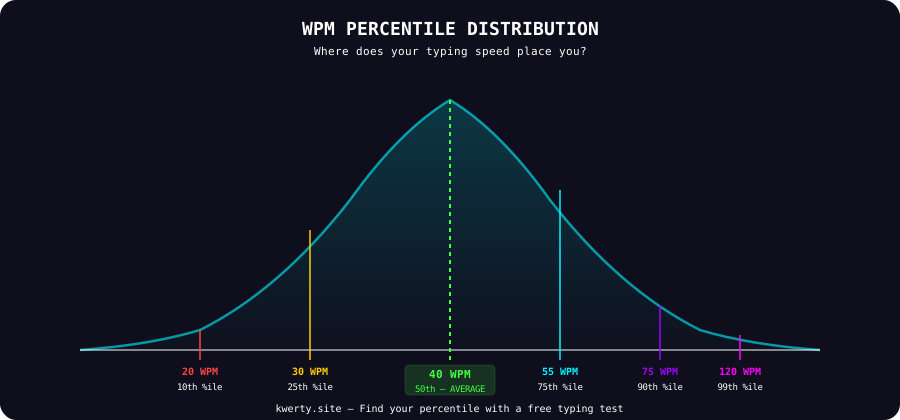
A typing speed percentile shows what percentage of typists you type faster than. If you score in the 90th percentile, you type faster than 90% of people. The chart below compares your WPM against the best scores of 253 real kwerty.site players, with the median at 40 WPM.
Step 1 — Get your WPM
TYPE THE PHRASE BELOW
Click here and type the words to check your speed
Once you have your WPM, scroll down to see exactly where you rank ↓
Step 2 — Compare yourself
WHERE DOES YOUR WPM LAND?
Data methodology
Percentile rankings are computed from the best WPM score of each of 253 real kwerty.site players (games recorded February–August 2026). Each player contributes one data point — their personal best — so repeat games don't inflate the curve. Bot and automated accounts are excluded. Snapshot: August 2026. Source data: kwerty.site leaderboard. For the full dataset — distribution histogram, accuracy vs speed, and mode pressure effects — see the typing speed statistics page.
How to read this chart
What's a percentile? It's simply the % of typists you're faster than. If you're in the 90th percentile, you type faster than 90% of people.
Reading the bell curve: the wide middle is where most typists land (around 40 WPM = average). The tall narrow tails on each side are the slow and fast extremes — fewer people, more spread out.
25th
~30 WPM
slower than most
50th
~40 WPM
average typist
75th
~55 WPM
top 25%
90th+
75+ WPM
top 10%
WPM PERCENTILE RANKINGS
Find your typing speed and see how you compare
You look at the keyboard while typing and use only a few fingers. Typing feels slow and deliberate.
Test yourself — see if you hit 20 WPM →
You know where most keys are but still glance down frequently. You can type basic messages but it takes time.
Test yourself — see if you hit 30 WPM →
You are at the median typing speed. Comfortable for casual use, but faster typists will outpace you in any productivity-focused role.
Test yourself — see if you hit 40 WPM →
You type faster than three out of four people. Solid touch-typing skills. Comfortable for most office and writing tasks.
Test yourself — see if you hit 55 WPM →
Top 10% territory. You have strong touch-typing technique and rarely look at the keyboard. Writing and coding feel effortless.
Test yourself — see if you hit 75 WPM →
Faster than 19 out of 20 typists. At this speed you can transcribe speech in near real time and your typing never bottlenecks your work.
Test yourself — see if you hit 90 WPM →
The top 1%. Only dedicated competitive typists and professionals reach this level. Your fingers move faster than most people can read.
Test yourself — see if you hit 120 WPM →
Find your WPM percentile
WHERE DOES YOUR WPM RANK?
Enter your WPM below to see exactly where you stand against 253+ real players on Kwerty's leaderboard. Real data, no estimates — updated from the live score table.
Percentiles derived from 253 real Kwerty players (best WPM per player, bot accounts excluded). Snapshot last updated 2026-05-28. The leaderboard itself updates live at /leaderboard.
HOW WPM IS CALCULATED
WPM = (characters typed ÷ 5) ÷ minutes
A “word” in WPM is standardized to 5 characters (including spaces), so long and short words count equally. Type 300 characters in one minute and that's 60 WPM — regardless of which words they were.
Most tests (including kwerty) report net WPM, which only counts correctly typed words — so accuracy directly lowers or protects your score. That's why accuracy-first practice beats raw speed-chasing.
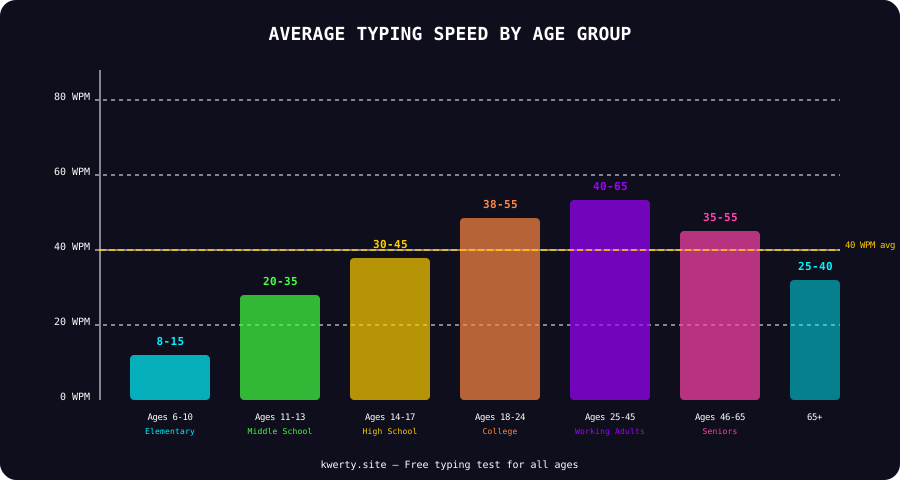
AVERAGE SPEED BY AGE
| Age group | Typical WPM |
|---|---|
| Elementary (8-11) | 8-15 |
| Middle school (11-14) | 20-35 |
| High school (14-17) | 30-45 |
| College (18-24) | 38-55 |
| Working adults (25-54) | 40-65 |
| Seniors (55-64) | 35-55 |
| 65+ | 25-40 |
Typing speed is a muscle-memory skill: people who learn touch typing between ages 8-12 tend to stay fast for life, but adults can absolutely still learn — it just takes more deliberate practice.
IS X WPM GOOD?
Look up any typing speed — verdict and percentile at a glance
| Speed | Percentile | Verdict |
|---|---|---|
| 20 WPM | 10th | Slow |
| 30 WPM | 25th | Below average |
| 40 WPM | 50th | Average |
| 50 WPM | ~67th | Decent |
| 60 WPM | ~78th | Good |
| 70 WPM | ~86th | Good |
| 80 WPM | ~92nd | Very good |
| 90 WPM | ~95th | Very fast |
| 100 WPM | ~96th | Expert |
| 110 WPM | ~98th | Expert |
| 120 WPM | 99th | Elite |
| 130+ WPM | 99th+ | Elite |
In-between number like 37, 63, or 94 WPM? Use the percentile calculator above for an exact rank, or take a fresh test — speeds usually shift a few WPM between tests anyway.
WHAT SPEED DO YOU NEED?
Recommended typing speeds for different activities
SCHOOL & COLLEGE
Target: 50+ WPMStudents who type at 50+ WPM can take notes faster, write essays more efficiently, and complete online assignments quicker than their peers. In timed exams, typing speed directly translates to more content produced.
OFFICE & BUSINESS
Target: 60-70 WPMOffice workers type an average of 40 WPM, but those who reach 60-70 WPM handle email, reports, and documentation significantly faster. In customer-facing roles, faster typing means shorter wait times.
SOFTWARE DEVELOPMENT
Target: 70-80 WPMDevelopers benefit from speeds above 60 WPM for regular text. Code typing is slower due to special characters, so a developer typing regular text at 80 WPM might code at 50-60 effective WPM, which is still highly productive.
COMPETITIVE TYPING
Target: 100+ WPMCompetitive typists on platforms like Kwerty, TypeRacer, and Monkeytype regularly exceed 100 WPM. Top competitors sustain 150+ WPM and burst above 200 WPM on familiar text. This requires years of deliberate practice.
HOW TO MOVE UP THE CHART
Three steps to climb the percentile rankings
TEST YOUR BASELINE
Before you can improve, you need to know where you stand. Take a 60-second typing test on Kwerty to establish your current WPM. This is your starting point.
PRACTICE TOUCH TYPING
Touch typing means using all ten fingers without looking at the keyboard. If you still hunt and peck, switching to touch typing is the single biggest improvement you can make.
TRAIN CONSISTENTLY
Spend 15-20 minutes daily on Kwerty. Consistency beats marathon sessions. Your muscle memory improves between sessions, so daily short practices yield the fastest gains.
WHAT'S YOUR PERCENTILE?
Quick check — type the phrase below and see where you land on the chart
Click here and type the words to check your speed
Want to climb the percentile chart?
A REAL KEYBOARD IS THE #1 UPGRADE
If you're typing on a laptop or a $10 membrane board, you're leaving 5-15 WPM on the table. Not because a mechanical keyboard is faster — because consistent feedback helps you build muscle memory faster. Most typists jump one full percentile bracket within 2-4 weeks of upgrading.
Keychron K2
from $50MOST POPULARWireless, 75% layout, hot-swap switches so you can try Brown / Red / Blue and see what feels right. Mac + PC out of the box. The keyboard 90% of typists buy first — priced right, built to last.
Save $25 this week · Keychron direct
Amazon Associate + Keychron Affiliate — we earn on qualifying purchases
SPEED CHART FAQ
Common questions about typing speed and percentiles
What is the average typing speed?
The average typing speed is 40 WPM (50th percentile). On the kwerty.site dataset of 250+ real players (best score per player, bots excluded), half typed faster than 40 WPM and half typed slower. The global adult average sits between 38-44 WPM depending on the measurement source — office workers cluster around 40-45 WPM, students around 35-40 WPM.
What typing speed puts you in the top 10%?
75 WPM puts you in the top 10% of typists (90th percentile on the kwerty.site dataset). Reaching 75 WPM typically takes 6-12 months of daily touch-typing practice from a starting baseline of 30-40 WPM. Solid touch-typing technique and all-ten-finger usage are the consistent factors among typists who reach this tier.
How fast is 100 WPM?
100 WPM is faster than approximately 95% of typists (95th percentile). Most software engineers, transcriptionists, and professional writers fall in the 60-85 WPM range — 100 WPM is the entry point to competitive typing. At 100 WPM you can type a 250-word email in about 2.5 minutes.
What is the world record typing speed?
The world record for sustained typing speed is 212 WPM, held by Barbara Blackburn on a Dvorak keyboard layout. For a single burst, Stella Pajunas typed 216 WPM on an IBM electric typewriter in 1946. Modern competitive typists on TypeRacer and Monkeytype regularly hit 200+ WPM bursts on short texts.
How quickly can I improve my typing speed?
Most typists gain 10-15 WPM in 30 days of consistent practice (10-20 minutes daily). Reaching 60 WPM from a 30 WPM baseline typically takes 2-3 months. Plateaus past 80 WPM require deliberate practice on specific weak letter pairs and consistent touch-typing form rather than additional speed drills.
Is 60 WPM a good typing speed?
Yes — 60 WPM is a good typing speed. It sits around the 78th percentile, faster than roughly 3 out of 4 typists, and clears the 40-60 WPM bar most typing-heavy jobs expect. 60 WPM with 96%+ accuracy is a genuinely strong combination: accuracy above 95% means your net speed holds up in real work, not just in short tests.
Is 80 WPM good?
Yes — 80 WPM is very good. It lands around the 92nd percentile on the kwerty.site dataset, faster than about 9 in 10 typists. Most professional typists — writers, developers, transcriptionists — work in the 60-85 WPM range, so at 80 WPM typing stops being the bottleneck in any office job.
Is 50 WPM good?
50 WPM is slightly above average. The adult median is 40 WPM, so 50 WPM makes you faster than roughly 2 out of 3 typists — comfortable for school, email, and general office work. Reaching 60-70 WPM from a 50 WPM baseline typically takes 4-8 weeks of daily accuracy-first practice.
Is 130 WPM fast?
Yes — 130 WPM is exceptionally fast. The 99th percentile starts at 120 WPM, so 130 WPM puts you in the top 1% of all typists. Speeds like this usually come from years of touch typing combined with deliberate competitive practice on platforms like Kwerty, Monkeytype, or TypeRacer.
Does a mechanical keyboard make you type faster?
Not by itself — no keyboard adds words per minute on its own. What a keyboard changes is accuracy: switches with a consistent actuation point (typically 45–55 g of force and about 2 mm of pre-travel) give clearer feedback than shallow laptop or membrane keys, and fewer errors means fewer corrections, which is where most typists lose speed. Tactile switches (Brown-type) are the most common choice for typing, linear switches (Red-type) for quiet shared spaces, and clicky switches (Blue-type) add sound without adding speed. Kwerty ranks keyboards by need: best for typing overall, best under $50, quietest, and best for RSI.
FIND YOUR PERCENTILE
Take a free typing test on Kwerty and discover exactly where you rank on the speed chart. Track your progress as you climb from average to elite.
FIND MY PERCENTILE